



Why Your Car Pulls After Potholes — 4-Wheel Alignment for Confident Driving around Madison, WI
Russ Darrow Mazda of Madison – Why Your Car Pulls After Potholes — 4-Wheel Alignment for Confident Driving around Madison, WI
Wondering why your car suddenly pulls after a Beltline pothole or a tight curb kiss near Capitol Square? Wheel alignment is the quiet foundation of stable, confident driving. When camber, caster, and toe drift out of spec, the wheel no longer sits naturally on center. That means constant corrections on East Washington Avenue, inside-edge wear by the time you reach Middleton, and a less-relaxed commute overall. Alignment does not just protect tires; it restores the poised, trustworthy feel you expect every time you merge, brake, and change lanes.
What a 4-wheel alignment actually fixes
Alignment sets three angles. Camber is the inward/outward tilt of the wheel that shapes tire contact during cornering. Caster is the fore-aft tilt of the steering axis that stabilizes straight-ahead tracking and on-center feel. Toe is the inward/outward angle of the wheels relative to the car’s centerline, which strongly affects tire scrub and directional stability. When potholes, curb impacts, or suspension wear change these angles, the steering wheel might sit off-center, the vehicle may drift on a level street, and tread blocks can feather or cup. A 4-wheel alignment measures all four corners, sets the thrust line from the rear, and then centers the steering to that line so the vehicle naturally tracks straight—no fight, no wander.
Modern crossovers and sedans benefit most because precise geometry supports electronic stability control and driver-assistance features. With correct angles, the car responds linearly to small inputs, lane changes feel tidy, and braking stays settled. That calm, predictable feel is what reduces fatigue on longer runs and tightens safety margins in busy city traffic.
Symptoms you can spot on Madison roads
Road crowns on neighborhood streets, freeze-thaw heaves, and frequent roundabouts add up. If your steering wheel is off-center on John Nolen Drive or the car drifts toward the shoulder on a flat section of US-12/18, alignment is suspect. Uneven tread—especially worn inner shoulders on the fronts—signals excessive negative camber or toe-out. If a balancing service smooths vibration but a shimmy returns a few weeks later, geometry may be nudging the tire into a wear pattern that brings the shake back. Minor pulling after fresh tires? New rubber magnifies old angles, so alignment becomes the next smart step.
- Persistent drift: Vehicle moves left or right on a straight road without steering input.
- Off-center wheel: The steering wheel is not level while driving straight, even after a wheel balance.
- Uneven wear: Inside or outside shoulder wear, or feathered tread you can feel by hand.
- Turn squeal: Tires chirp in parking lots or tight turns due to excessive scrub.
- New-tire pull: Fresh tires highlight geometry problems that were masked by worn rubber.
Addressing these signs early preserves tread life and protects braking stability on damp surfaces along Lake Monona and Lake Mendota.
Why balancing and rotations work best with alignment
Balancing cancels vibration from tiny mass differences in each wheel-tire assembly. Rotations spread load and wear across all four corners, which is especially important for all-wheel-drive vehicles that prefer equal tread depth. Alignment then sets the geometry so those balanced, rotated tires roll straight. The trio works together: balance removes shimmy, rotation shares the workload, and alignment stops the scrub that chews up shoulders on crowned side streets. If the tread is heavily cupped, alignment can still help, but new tires may be required to break the vibration cycle for good.
For commuters crossing town or coming from neighborhoods near Sun Prairie, WI, pairing alignment with balancing and rotations keeps the wheel calm on the Beltline, sharpens response for on-ramps, and extends tire life so maintenance dollars stretch farther.
Professional process, real-world validation
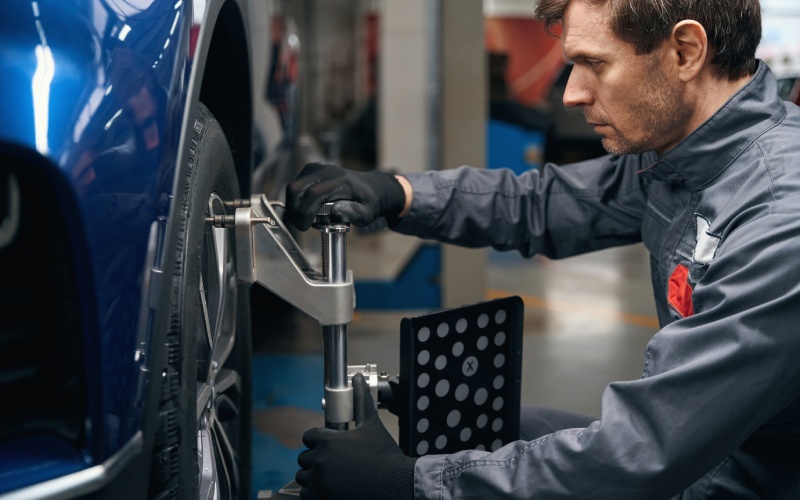
Professional alignment begins with a suspension and steering inspection. If a tie rod end or control arm bushing has play, angles will not hold. Once hardware is healthy, technicians place the vehicle on alignment equipment, measure current camber, caster, and toe, and adjust to target values informed by the vehicle’s specifications. Steering angle sensor reset often follows, so stability systems read straight-ahead accurately. Finally, a test drive confirms on-center feel, return-to-center behavior after turns, and braking stability on local pavement. Measurements show what changed; the drive proves how it feels.
Frequently Asked Questions:
How often should I get an alignment?
Plan for a check every 12 months or 12,000–15,000 miles, and any time you notice drift, install new tires, or strike a notable pothole or curb.
Do I need an alignment with new tires?
Yes. Correct geometry helps protect your new investment, prevents rapid shoulder wear, and keeps the wheel level and calm.
Will alignment stop highway vibration?
Alignment fixes drift and scrub. Vibration usually points to imbalance, bent wheels, or cupped tread. Combine balancing, rotation, and alignment for lasting smoothness.
How long does a 4-wheel alignment take?
About an hour, once adjustments move freely and hardware passes inspection. Extra time may be needed if parts are worn or seized.
Alignment is not just a box to check; it is a direct investment in safety, comfort, and tire longevity. Proper angles keep your car tracking true on crowned city streets and stabilize the chassis when you brake hard for a sudden stoplight change on University Avenue. When the wheel stays level, and the car goes where it is pointed, driving feels easier—because it is.
Our team understands how Madison pavement shapes real-world alignment needs, from the Beltline’s rhythmic joints to older neighborhood streets where crowns are pronounced. If the car has started to wander or the front tires wear in stripes, schedule a 4-wheel alignment and a tire health check together. One visit restores straight-ahead confidence and puts you back on the road feeling calm, composed, and ready for the next commute.
When you are ready, Russ Darrow Mazda of Madison can inspect suspension components, adjust geometry precisely, balance wheels, and rotate tires so everything works together. That way, the next time you leave a parking lot onto John Nolen Drive or merge onto US-12/18, the steering feels settled, and the car follows your hands without a second thought.
0 comment(s) so far on Why Your Car Pulls After Potholes — 4-Wheel Alignment for Confident Driving around Madison, WI